
Custom touchscreen gloves have become increasingly important for fashion and winter gloves. But for brands and importers developing a custom glove collection, adding touchscreen capability is not simply a matter of choosing a conductive material.
The glove material, construction, lining thickness, touchscreen area and even the final fit can all affect how well the finished glove works.
Based on our hands-on experience developing gloves for international brands and importers, this guide explains the most common touchscreen solutions, their advantages and limitations, and several production issues buyers should consider before placing an order.
1. Conductive Materials for Custom Touchscreen Gloves
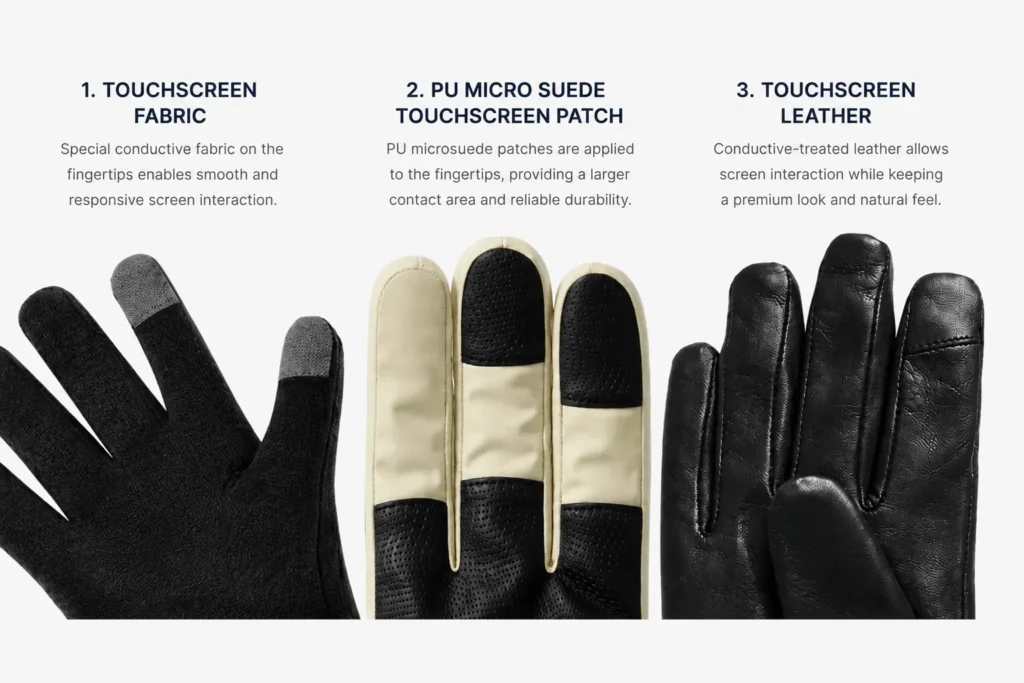
One of the cleanest solutions is to use a material that is already touchscreen-compatible.
This is particularly suitable for fashion gloves where brands want to maintain a simple appearance without adding visible patches or embroidery.
Touchscreen Leather and Vegan Leather
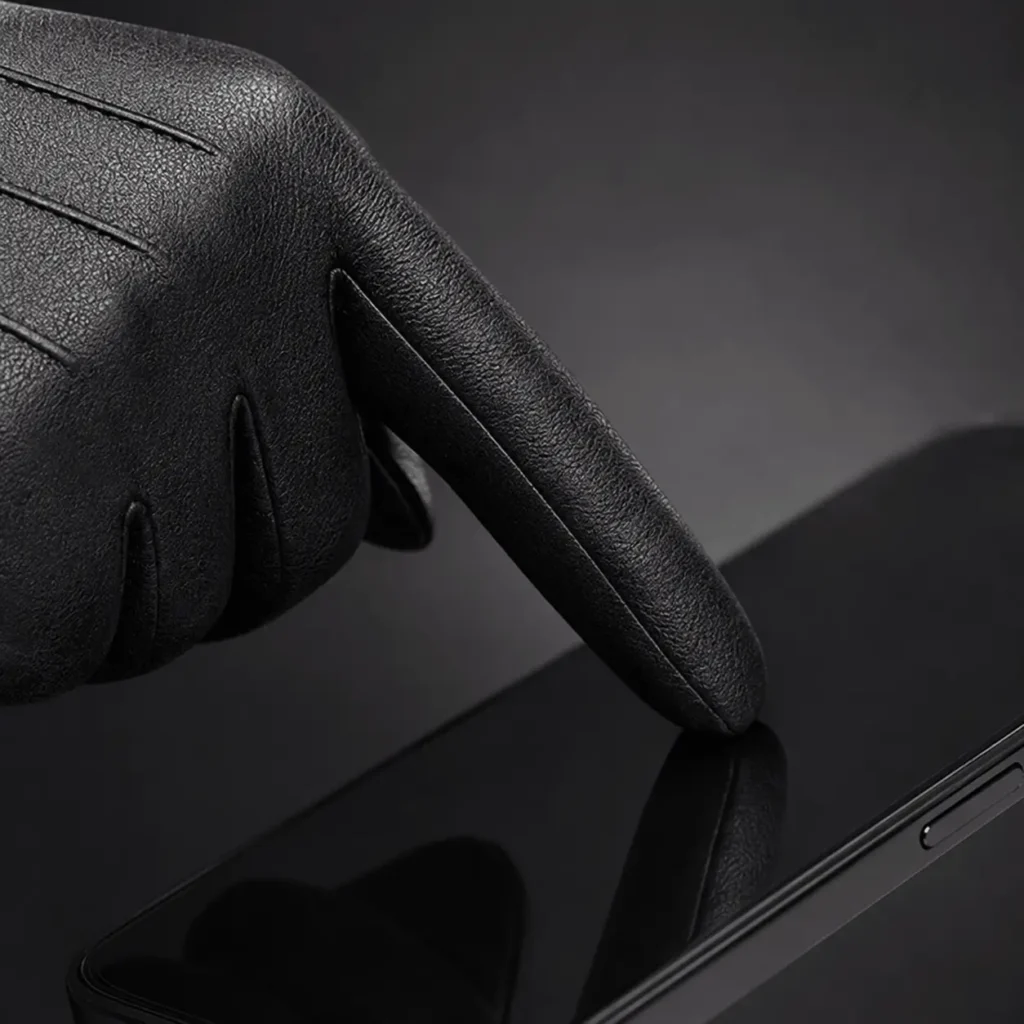
For leather and synthetic leather gloves, conductive treatments can be incorporated into the material so that the fingertip—or sometimes a larger area of the glove—can interact with a capacitive touchscreen.
The main advantage is appearance. There is no obvious touchscreen patch on the fingertip, making this solution particularly suitable for classic leather gloves and minimalist fashion designs.
However, performance should always be tested using the actual material selected for production. Different leather finishes, PU constructions and thicknesses can produce different results.
Conductive Fabrics and Knitted Materials
For fabric gloves, conductive fibers can also be incorporated into the yarn or fabric construction.
This solution can work well for knitted gloves and certain technical fabrics because the touchscreen function becomes part of the material rather than an additional component.
Again, the final result depends not only on the outer material but also on the complete glove construction.
2. Conductive Touchscreen Patches
Conductive patches are one of the most established methods of adding touchscreen functionality.
A conductive material is sewn onto the fingertip, usually on the thumb and index finger.
Common options can include:
- Conductive microfiber or microsuede
- Technical nylon fabrics
- Conductive PU materials
- Conductive leather
The biggest advantage of a patch is its relatively large contact area and stable performance.
For this reason, patches remain useful for ski gloves, outdoor gloves, cycling gloves and other styles where functionality and durability are more important than maintaining a completely clean fashion appearance.
The Main Limitation: Appearance
For fashion gloves, a patch can sometimes look too technical.
Color matching can also become a problem. If a brand requires a specific seasonal Pantone color, finding conductive patch material in exactly the same shade may not always be possible.
This is one reason why many fashion glove designs now use more discreet touchscreen solutions.
3. Conductive Embroidery
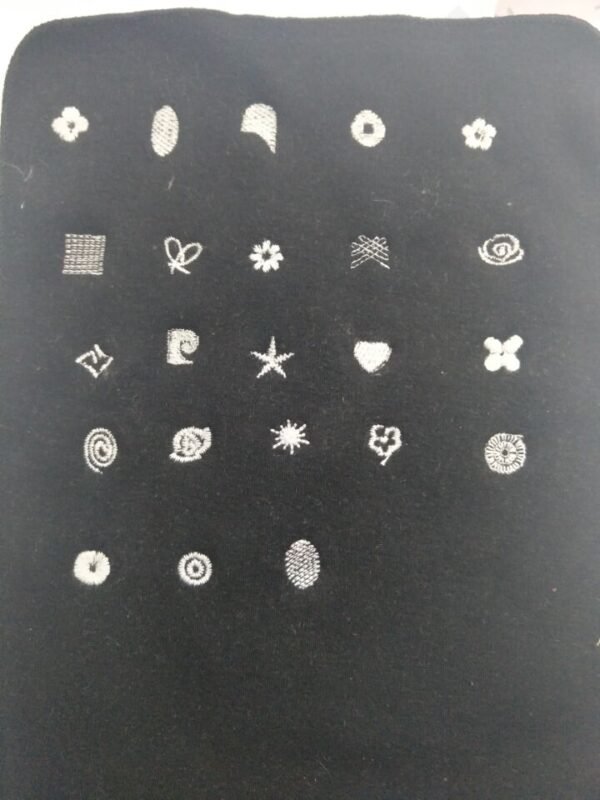
Conductive embroidery has become an increasingly useful solution for fashion and textile gloves.
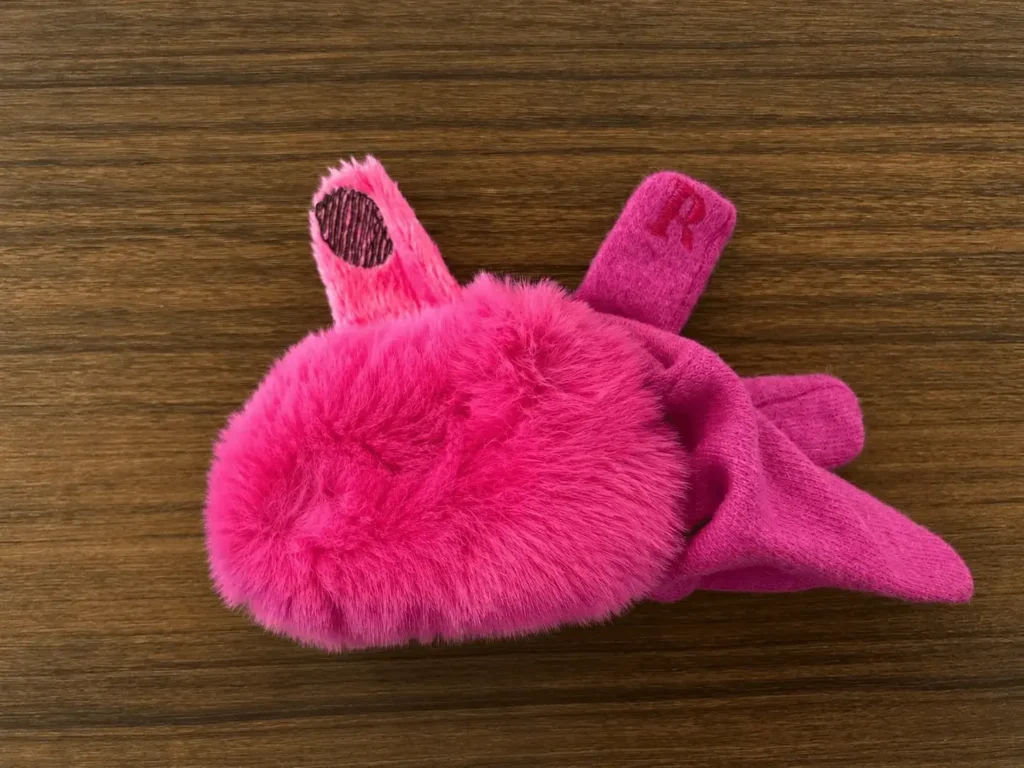
Instead of adding a separate patch, conductive thread is embroidered directly onto the fingertip, normally on the index finger and thumb.
For fashion brands, this offers several advantages.
More Design Flexibility
Embroidery can be made into different shapes and patterns.
A simple line, circle or fingerprint-style pattern can keep the design subtle, while a customized pattern can also become part of the glove’s visual identity.
The thread color can also be selected to either blend with the glove or intentionally create contrast.
This makes conductive embroidery particularly suitable for fashion-oriented fabric gloves where appearance is important.
Pay Attention to Needle Detection Requirements
The composition of conductive thread is also important.
Some conductive threads contain metallic fibers such as stainless steel. These materials can provide good touchscreen performance, but they may create problems when a customer’s quality-control procedure requires sensitive metal or needle detection.
For orders with strict needle-detection requirements, including certain Japanese retail programs, the conductive thread should therefore be confirmed during the development stage.
Alternative conductive thread constructions, including silver-fiber options, may be considered depending on the customer’s testing requirements.
The important point is simple:
Touchscreen performance should not be considered separately from the buyer’s quality and inspection requirements.
4. Conductive Printing
Conductive printing is another option for certain lightweight fabric gloves.
A conductive printing material can be applied to selected areas of the fingers or palm. Depending on the design and material used, the print may provide both touchscreen functionality and additional grip.
This can make it useful for products such as:
- Running gloves
- Driving gloves
- Lightweight winter gloves
- Casual touchscreen gloves
The suitability of printing depends heavily on the base fabric, elasticity and required durability, so testing before bulk production is important.
5. A Commonly Overlooked Problem: The Lining
This is one of the most important issues in touchscreen glove development.
A buyer may select an outer material with excellent touchscreen performance and still find that the finished glove does not respond well.
Why?
Because the user’s finger is not touching the outer shell directly.
There may be fleece, faux shearling, cashmere, Thinsulate™ or another insulation layer between the finger and the conductive outer material.
The thicker or more insulating the lining becomes, the more difficult it may be to maintain a reliable conductive path between the hand and the touchscreen.
Test the Complete Glove, Not Just the Material
This is why testing a piece of conductive fabric alone is not enough.
The touchscreen function should be evaluated again after the outer shell, lining and other components have been assembled into the actual glove.
For conductive embroidery, the construction may need to allow the conductive element to connect effectively through the glove layers.
For patch-based solutions, the appropriate construction depends on the conductivity of the selected material and the thickness of the lining.
This should be confirmed during sampling rather than after bulk production.
6. Fit Also Affects Touchscreen Performance
Another factor that is sometimes overlooked is glove fit.
Even when the correct conductive material is used, a glove with too much empty space at the fingertip may not perform as well as expected.
For touchscreen use, the finger should normally sit reasonably close to the end of the glove so that the conductive area can make consistent contact with the screen.
This becomes particularly important when developing:
- Unisex sizing
- One-size gloves
- Thick winter gloves
- Gloves with heavy insulation
A touchscreen problem is therefore not always a material problem. Sometimes adjusting the pattern or fingertip fit can improve the user experience.
7. Test Touchscreen Performance on More Than One Device
Touchscreen sensitivity can vary between devices, and screen protectors can also affect responsiveness.
For this reason, we recommend testing finished samples on several commonly used smartphones rather than relying on a single device.
Testing should include basic real-world actions such as:
- Tapping icons
- Swiping
- Typing
- Scrolling
- Using both the thumb and index finger
The purpose is not to create an unnecessarily complicated laboratory test. It is simply to make sure the finished glove works reliably under realistic consumer use.
Most importantly, testing should be carried out on the finished glove, not only on the touchscreen material before production.
8. Which Touchscreen Solution Should You Choose?
Choosing the right solution for custom touchscreen gloves depends on the glove material, design, target performance and price level.
| Glove Type | Commonly Suitable Solution | Main Consideration |
|---|---|---|
| Fashion leather gloves | Conductive leather/material | Clean appearance |
| Vegan leather gloves | Conductive PU/material | Material quality and consistency |
| Fashion fabric gloves | Conductive embroidery | Appearance and color flexibility |
| Knitted gloves | Conductive yarn or embroidery | Stretch and construction |
| Ski & outdoor gloves | Conductive patch | Durability and contact area |
| Running gloves | Embroidery or conductive printing | Lightweight construction |
| Thick insulated gloves | Depends on construction | Lining must be considered |
This table should be treated as a starting point rather than a fixed rule.
For a custom project, we normally recommend choosing the touchscreen method only after the outer material, lining, glove construction and target price have been confirmed.
9. Questions Buyers Should Ask Before Sampling
Before developing a custom touchscreen glove, it helps to clarify several points with your supplier:
- Which fingers need touchscreen functionality?
- Is appearance or maximum touchscreen performance more important?
- What outer material will be used?
- How thick is the lining?
- Does the customer require metal or needle detection?
- Does the touchscreen element need to match a specific Pantone color?
- Will the glove be used mainly for fashion, everyday wear, running, skiing or another activity?
- Has the finished glove—not only the material—been tested on multiple devices?
Answering these questions early can prevent unnecessary sample revisions later.
Touchscreen Gloves Are a Complete-Product Decision
One of the biggest lessons from developing touchscreen gloves is that the touchscreen component cannot be considered in isolation.
When developing custom touchscreen gloves, we normally evaluate the material, lining and construction together rather than treating touchscreen capability as a separate feature.
A conductive thread may work perfectly by itself but perform differently after a thick lining is added.
A conductive patch may provide excellent functionality but not match the aesthetic expectations of a fashion collection.
A clean-looking touchscreen leather may be ideal for one style but unnecessary for another.
The best solution is therefore not necessarily the most technically advanced one. It is the solution that provides the right balance between function, appearance, construction, cost and the customer’s quality requirements.
At RX Accessories, we work with brands, importers and retailers on private-label fashion glove development, including leather, vegan leather, fabric, knitted and insulated glove constructions.
If you are developing a custom touchscreen glove, we can help evaluate the material, lining, touchscreen method and construction during the sampling stage before moving into bulk production.